
Inside this article:
- Step 1: Phonogram Drill
- Step 1: Word Card Routines
- Step 2: Phonological Awareness
- Step 2: Phoneme Segmentation
- Step 3: Word Building: Magnetic Board
- Step 3: Word Building: Phoneme/Grapheme Sheet
- Step 4: Word Decoding
- Step 5: Pre-Reading Written Script
- Step 6: Word Find and Sentence Reading (introductory lesson)
- Step 6: Passage Reading and Comprehension (reinforcing lesson)
- Step 7-10: Dictation
- Step 7: Sound Dictation
- Step 8: Phonemic Awareness Pre-Spelling
- Step 9: Spelling
- Step 10: Sentence Dictation
Step 1: Phonogram Drill
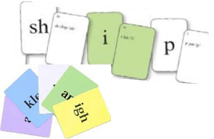
- Shuffle the cards.
- Students provide letter name and sound for phonogram cards. (Cards may be named as a group in unison or one at a time progressing around the group.)
- If a student makes a mistake, correct and have him/her say the name and sound correctly.
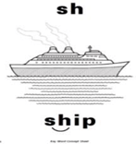
- Teacher explicitly provides explanation for new sounds introduced using the Key Concept Picture.
Step 1: Word Card Routines
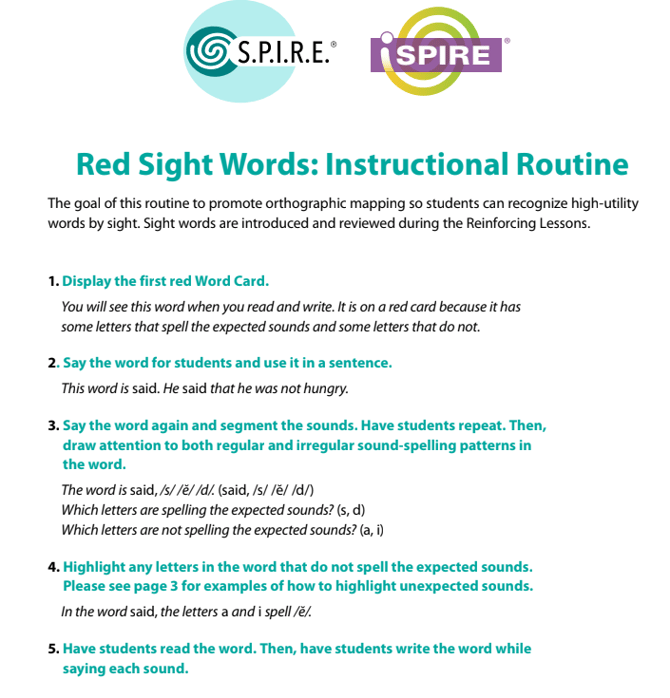
- When beginning a new level of S.P.I.R.E., add 5 Red Sight Word Cards a week until all words have been introduced.
- When teaching the first Reinforcing Lesson for a concept, introduce all the Decodable 1 (green) or Decodable 2 (yellow) word cards for the concept.
- Continue to practice the Decodable 1 or Decodable 2 set of word cards in Step 1 of every lesson until students read the words with 80% accuracy
Step 2: Phonological Awareness
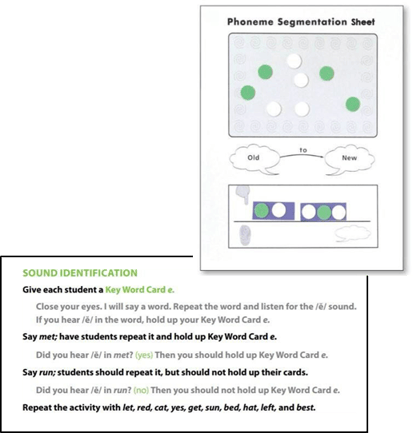
- Students are explicitly guided through a hierarchy of activities and respond to verbal questions and directions.
- Teacher follows written script for one or more of the following activities:
-
Rhyming
-
Sound providing
-
Sound Categorization
-
Blending
-
Segmenting
-
Deletion and/or
- Substitution
-
Step 2: Phoneme Segmentation
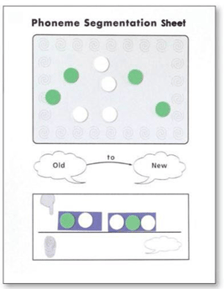
- Students place six white and three green sound circles in the gray box at the top of the worksheet.
- Teacher orally says a word: “ ”
- Students tap/count the sounds in the word
- Students repeat word and place a sound circle on the line at the bottom for each sound in the word, using green circles for vowels and white circles for consonants. (brush: white white-green-white)
- Students touch each circle and say the sounds in the word slowly and then quickly blend the word.
- Teacher says, “Change to ” while touching old to new. Students repeat and make changes to word.
Step 3: Word Building- Magnetic Board 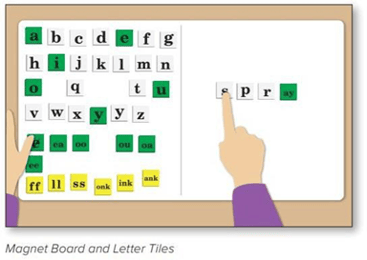
- Teacher dictates word.
- Students count the sounds they hear.
- Students spell the word with the letter magnets making sure to use the appropriate magnet for vowel teams and patterns.
- Students point and say the sounds in the word slowly, sound by sound, then blend the word quickly.
- Students replace the letter magnets or change one sound in the existing word according to teacher directions.
- Teacher may ask students to use word in a sentence.
Step 3: Word Building- Phoneme/Grapheme Sheet
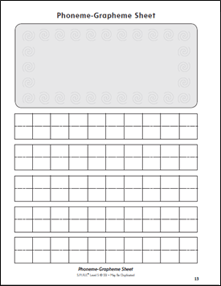
- Sound circles are placed in the gray box.
- Teacher dictates a word.
- Students repeat the word and count the sounds.
- Students place a sound circle in each sound box for the sounds in the word.
- Students point to the circles and say the sounds in the word.
- Students push up the circles and write the letter(s) that make the sounds in the word.
Step 4: Word Decoding
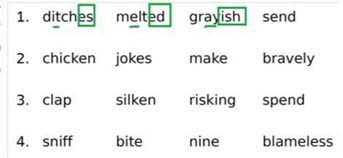
- Teacher directs student to look at the
- Students look carefully at the vowels and patterns in the words and underline vowels and mark other patterns in the word they have learned (digraphs, vowel teams, and syllables).
- Students read the words by saying the name of the vowel then the vowel sound and then decoding the word (ex: “i, /i/, ship,” “a, /a/, tack”, “a consonant e, /a/, lake.)
- Vocabulary is discussed as needed, focusing on multi-meaning words, synonyms, homonyms,
Best Practices and Author’s Suggestion: Require students to read the word as follows: saying the name of the vowel, then the vowel sound, and finally decoding the word. (see bullet 3). This decoding strategy moves students away from glancing-and-guessing and increases accuracy.
Step 5: Pre-Reading Written Script
*script will vary depending on concept
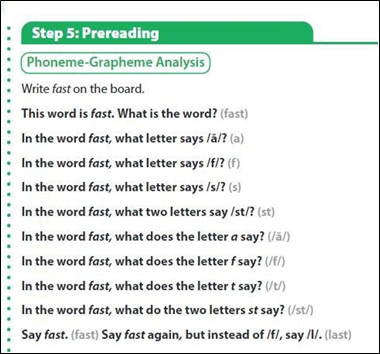
Write the target word on the board.
- This is the word. What is the word?
- In the word, what letter says / /?
- In the word, what two letters say / /?
- In the word. what letter says / /?
- In the word, what do the two letters say?
- In the word, what does the letter say?
- In the word, what does the letter say?
- How many sounds do you hear in the word?
- Say____. Say____ again, but instead of / / say / /.
Step 6: Word Find and Sentence Reading (Introductory Lesson)
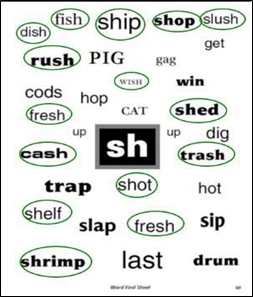
- Students circle the words that have the target
- Students may highlight the target sound in the
- Each student says a word, discusses meaning, and uses the word in a sentence. Other students check the word off on their word find sheets.
- Teacher writes sentences from Teacher’s Guide on the board.
- Students read sentences and discuss
Best Practices: Write sentences on the board (SMART Board, white board) to use with students during teacher-directed instruction. Then, direct students to their workbook to code words as needed.
Step 6: Passage Reading and Comprehension (Reinforcing Lesson)
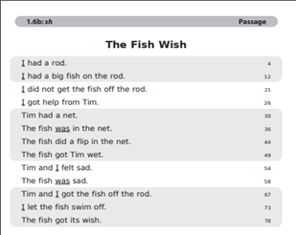
-
Teacher follows the script for explicit story comprehension.
-
Teacher and students fill out a comprehension graphic organizer together. (optional)
- *Students reread the passage for (optional)
- Students refer to reading passages when completing the workbook pages during independent activities.
Best Practices: To maximize time, the teacher fills out a class Graphic Organizer while students provide answers. The goal of Step 6 is to build students’ general understanding through oral discussion following reading of the text and deepen comprehension skills with use of the Graphic Organizer.
Steps 7-10: Dictation
- Students may complete five to ten examples.
- Students should write all patterns they have been introduced to that have a particular sound.
- Teacher led learning activity; this is not a daily spelling test.
- Vocabulary and meaning are embedded into the dictation steps.
Step 7: Sound Dictation
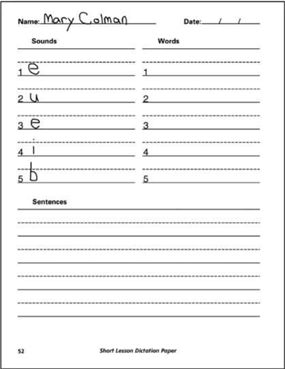
- Teacher says: “What letter(s) says //.”
- Students repeat sound, give letter name.
- Students may trace letter in their palms.
- Students write letter, naming the letter as they write.
Step 8: Phonemic Awareness Pre-Spelling
*Be sure to follow the script
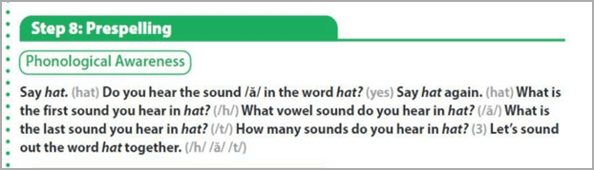
Teacher says:
- Say ____.
- What sound do you hear at the beginning of ____?
- What vowel sound do you hear in ____?
- What is the last sound you hear in ____?
- How many sounds do you hear in ____?
Step 9: Spelling
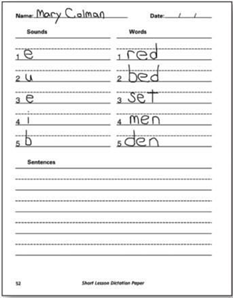
- Students may complete 5 to 10 examples
- Teacher says the word and uses it in a sentence, pronounces word again
- Students repeats word and sounds it out
- Students name letters to spell the word
- Students write word, naming the letters as they write
- Students read the word aloud (proofreading).
- After entire spelling list is dictated, teacher goes back to the beginning of list and students reread all words.
Step 10: Sentence Dictation
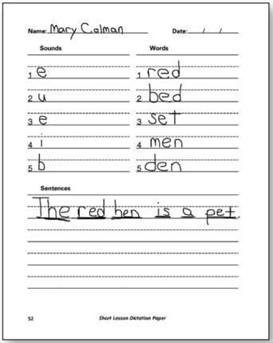
- Teacher says a sentence making a dash on the board as each word is said.
- Student says the sentence as the teacher points to each dash
- Student says the sentence again making a dash on the paper for each word.
- Student points to each dash and says the sentence
- Student writes the sentence saying each word aloud as it is written
- Student rereads the sentence checking for errors
- Errors are bracketed and the correction is written above/below the word.