The Reading Rope Insights Report uses Scarborough’s Reading Rope to provide a visual representation of each student’s literacy profile. The report aligns with the Science of Reading by weaving together the six key dimensions of reading ability and combining them into two broad domains—Word Recognition and Language Comprehension. These domains are then used to generate an overall reading mastery score, helping educators identify strengths and areas for growth.
Interactive Reading Rope Insights Report walkthrough available here
Locate the Reading Rope report:
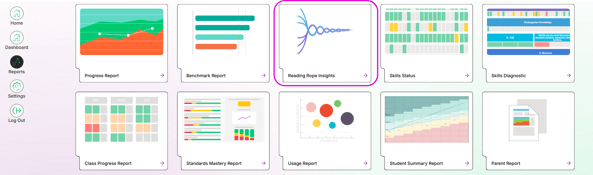
1. From the Growth Dashboard, click Reports at the top left section of the screen
2. Select Reading Rope Insights
The Reading Rope Insight Report summarizes performance from the most recent Benchmark assessment and Progress Monitoring Assessments in terms of key dimensions of the reading pillars from the Simple View of Reading Framework: Phonological Awareness, High Frequency Words, Vocabulary, Background Knowledge, Structures and Reasoning, and Decoding (Scarborough, 2001). The report also provides actionable ideas for helping students drive toward reading mastery.
Navigating the Report: 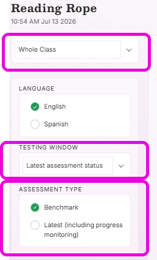
- Click the dropdown next to "Whole Class" to choose a specific student
- Select the desired Testing Window. Choices include the BOY, MOY, and EOY Benchmark windows as well as all Progress Monitoring periods.
- Choose the Assessment Type. "Latest" will show the most recent assessment, while "Benchmark" will only show a BOY, MOY, or EOY Benchmark.
Analyzing the Report:
-
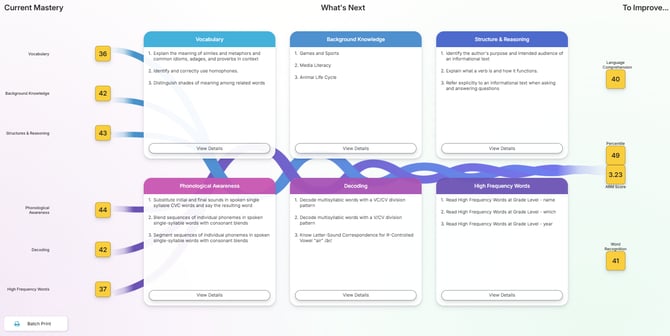
The data on the left side of the report shows you a student’s Mastery Profile against the Reading Rope. You can see at a glance where a student is “strong” and where they are “striving”. This profile is expressed through Percentile Rankings (PRs). Each student is compared to other students across the nation. If the student’s mastery level is higher than almost all students, their PR is 99. If a student is behind almost all students, the PR is 1. A student with an “average” level of mastery for their grade will have a PR of 50. You want to work on the areas where a student is weakest (has the lowest PR). These are color-coded as Blue, Green, Yellow, and Red.
- Instructional recommendations are listed within each domain tab. For more specific recommendations, click View Details. Selecting this option will open the Skills Diagnostic Report.
- The data on the right side shows you the student's composite percentile as well as the overall ARM Score.
- Select Batch Print to print all student Reading Rope reports.
Instructional Recommendations Tabs
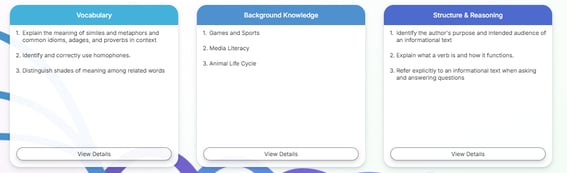
- Vocabulary - Reading Assistant estimates the number of words in a student's expressive vocabulary based on reading performance and generates lists of words that the student has likely mastered and those that are appropriate for targeted instruction. Use the words on the list to help the student grow vocabulary knowledge.
- Background Knowledge - Background Knowledge measures a student's understanding of vocabulary and content knowledge and is based on multiple sources of data. For new or infrequent users, the score primarily reflects vocabulary performance and fluency with less common words during assessment passages. For students who regularly practice with Amira, the score also incorporates mastery of knowledge-specific vocabulary encountered in texts across content areas, such as science and social studies. As a result, regular users receive a more comprehensive Background Knowledge score, while some new users or pre-readers may not receive a score if insufficient data is available.
- Structure and Reasoning - The score in the Structure and Reasoning tab is determined through a combination of factors that assess a student's understanding of how ideas are organized and connected within a text. This assessment is based on the student's reading behaviors and their responses to questions related to the passages they read.
-
Phonological Awareness -
Reading Assistant analyzes student reading to the phoneme level and suggests phonemes in the Phonological Awareness tab, so you can understand what students may have mastered and what you might use in targeted instruction. -
High Frequency Words -
Reading Assistant analyzes the probability that a student has mastered grade-level high-frequency words based on the student's assessment reading. Amira then suggests high-frequency words that the student has likely mastered and identifies words that can be used in targeted instruction to help the student master important high-frequency words. - Decoding - Reading Assistant analyzes student reading to identify decoding skills that the student has likely mastered and skills appropriate for the student's current development that you can use in targeted instruction to improve the student's decoding ability.